
Tulsa County Wanted Listings
The main public wanted list for this area is Tulsa Crime Stoppers' Most Wanted page. It is a community tip resource, not a Tulsa County Sheriff's Office roster. Each card highlights a person the organization identifies as wanted. The count shifts over time. Crime Stoppers adds and removes entries without a fixed schedule. Its category archive changes the same way.
A card serves two purposes. It helps you recognize someone, and it gives you a way to pass along a tip. It cannot tell you whether that person sits in county custody right now, since a card can stay up long after a status changes. A missing card does not mean no warrant exists either. Booking and release events belong to the county's custody records. Case outcomes belong to the court docket.
"Sheriff's Most Wanted" is just the navigation label used on this site. Crime Stoppers, not the sheriff's office, fills that public-list role locally. Knowing the difference keeps a tip channel from being mistaken for an official county database.
Tulsa Wanted Listing Fields
Crime Stoppers cards are informal compared with court records. Even so, the Tulsa listings tend to include enough identifiers that you rarely have to guess who you are looking at. Read each card exactly as the organization presents it. Think of it as a snapshot, not a warrant confirmation.
| Field | What the Tulsa card may show |
|---|---|
| Photograph | An identifying image displayed by Tulsa Crime Stoppers on its own wanted card. |
| Name | The name used by the list to identify the person associated with the wanted notice. |
| Personal descriptors | Race, sex, age or date of birth, plus such descriptors as height, weight, hair, and eye color. |
| Wanted allegation | An alleged wanted offense or warrant-related description, not a judicial finding of guilt. |
| Card availability | A dynamic listing that may be added, changed, or removed without a published cadence. |
No card or booking photograph is reproduced here. The images stay with the source, which keeps a live tip listing distinct from an official booking record and leaves the original publisher in charge of how each photo is displayed.
Read Tulsa Wanted Cards
Put a card to work in one of two ways. Recognize the subject, or decide that what you know should reach law enforcement. Do not track the person. Do not contact or confront them, and do not call them out publicly. A wanted list, a county warrant search, and a live custody inquiry are three separate tools. Keep them in their own lanes.
- Open the current Tulsa Crime Stoppers wanted page and read the complete card rather than relying on a name alone.
- Compare the descriptors shown on the card with information you actually know; do not infer identity from a partial match.
- Record only information that may help the official tip channel, such as a location or a recent observation, without attempting contact.
- For an immediate threat or sighting that needs an urgent response, call 911 rather than attempting an intervention.
- When an arrest occurs, the person may later appear in the county custody systems. The Tulsa County booking and custody guide explains how to check that separate record path.
Tulsa Crime Stoppers Tips
Tulsa Crime Stoppers is the channel TCSO points to for tips about wanted people. Callers can stay anonymous. The Sheriff's cold-case page also mentions a possible cash reward when a tip leads to an arrest and conviction, though nothing is guaranteed. Rewards follow the program's own terms. Check that page for current rules before counting on a payout.
Tulsa Crime Stoppers
Wanted-person tip channel
(918) 596-COPS (2677)
TCSO's Crime Stoppers guidance identifies anonymous tips and the possible reward condition.
Report what you know honestly. Let the agency handle everything after that. The tip line exists to gather information, nothing more. It cannot look up court files, clear a warrant, or tell you whether someone is sitting in the David L. Moss Criminal Justice Center.
Tulsa County Warrant Checks
Warrant checks in Tulsa run along two official routes. TPD's Warrant Search page sends municipal matters to the city's tool and county matters to a separate portal. For city cases, use Tulsa's municipal warrant search. County cases go through TCSO's linked Glyphreports warrant portal. Per TPD, both links search active warrants tied to Tulsa Municipal Court and Tulsa County District Court. Bookmark the official Tulsa County warrant portal for the county side.
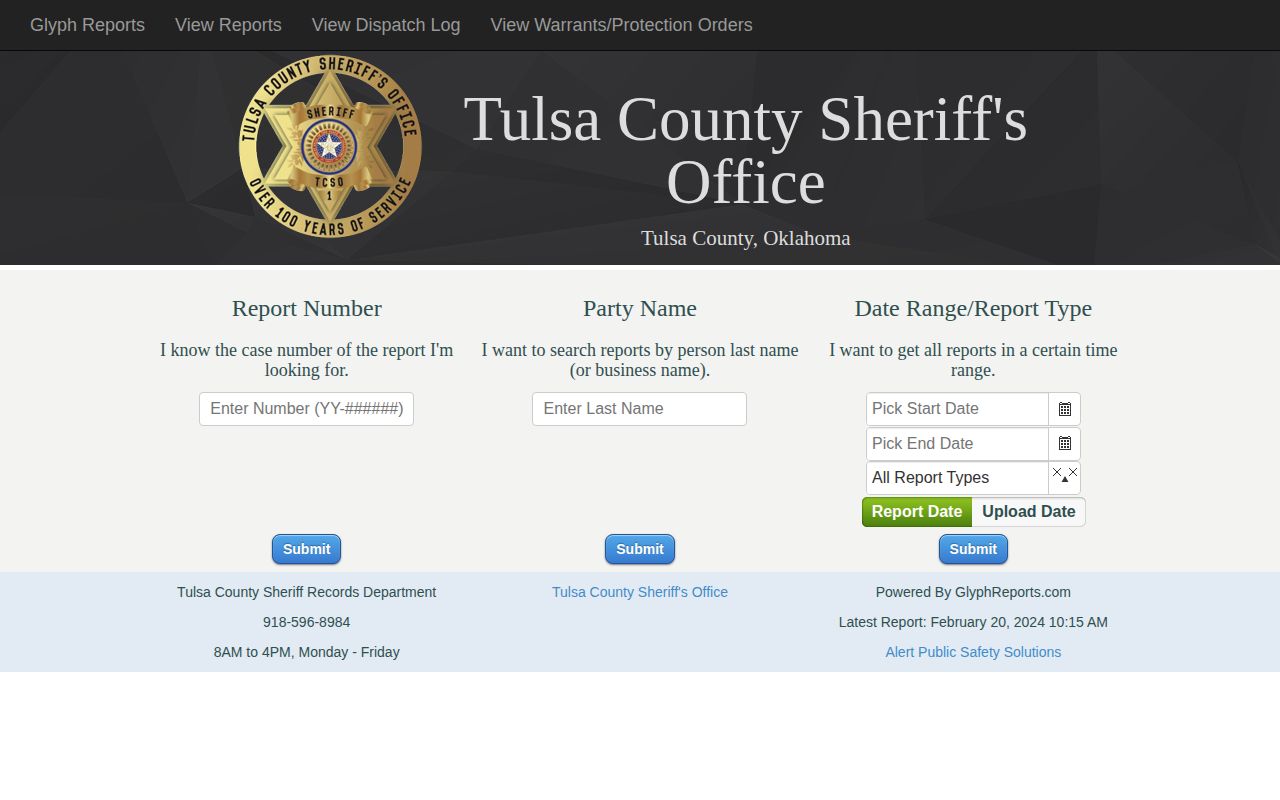
Treat whatever a portal shows as a starting point. Paperwork gets served, recalled, sealed, or stuck in a slow queue. So no result can promise a warrant is still open. Before acting on anything, confirm with the issuing court and agency.
The split design also guards against a common mix-up. A municipal case can slip past the county portal. The same goes the other way. A district-court matter may never show in a city search built for other cases. Match each result against the named court and the date on screen. No online tool can untangle a sealed record, a slow administrative update, or a change that has not yet surfaced in public view.
- Start at TPD's official warrant-search landing page to identify whether the matter belongs in the municipal or county path.
- Use the Tulsa municipal search for municipal-warrant information and the Glyphreports portal for the county warrant system.
- Read the returned information as current database reporting, not as a complete history or a final court decision.
- Use the issuing court clerk or agency to confirm a time-sensitive result, especially before appearing in person.
- Ignore unsolicited demands to pay a warrant by phone, gift card, or cryptocurrency. TCSO warns that legitimate warrant processes do not use those payment demands.
Tulsa Warrant Types
Warrant information in Tulsa is split by jurisdiction. There is no single countywide list. A municipal warrant, a district-court warrant, a wanted-person card, and an inmate record each answer a different question. Knowing which channel holds what saves time when you search.
| Record or status | Tulsa route | What it confirms |
|---|---|---|
| Tulsa municipal warrant | City of Tulsa municipal warrant search | Current reporting from the municipal-warrant channel. |
| Tulsa County warrant | TCSO-linked Glyphreports portal | Current reporting from the county warrant system. |
| Wanted-person card | Tulsa Crime Stoppers | A dynamic, tip-oriented request for information, not a complete warrant database. |
| Current jail custody | TCSO Inmate Information Center | Custody or booking information, which is separate from an unserved warrant. |
| Court case status | OSCN or the appropriate municipal court clerk | Court-side case information and later disposition details. |
A Tulsa warrant can sit in several states. It might be unserved, recently served, recalled, sealed, or simply waiting for an update to travel between systems. Someone can also be in custody on a fresh booking while never appearing on a public wanted card. So the question you ask shapes which office you ask.
Know the difference. A custody roster tells you who is in a jail system right now. A warrant search checks the active-warrant database instead. Neither is a final conviction record.
Verify Tulsa Court Records
Court records fill what a booking sheet leaves open. Start with OSCN's Tulsa docket search for any District Court case. You can query by party name, case number, date range, court or county, and case type. The docket may show filed charges, an amended information, a plea, or a dismissal. Deferred results, judgments, and sentences appear there too. That is why a wanted notice or jail booking can never stand in for the final outcome.
City cases run through a different door. The Municipal Court Clerk handles those, and the city warrant page lists the contact. TPD notes that its Records Section does not maintain convictions. Call a lawyer or the issuing court if a warrant looks wrong. Never pay a caller who demands money over one. Do not dodge the court or try to work off the wanted list.
Booking starts a case. It does not finish one. TPD holds municipal arraignment on weekdays at 8:30 a.m. Conferences, dispositions, and trial settings follow. County charges can be amended, dismissed, or deferred later, and none of that shows in the jail record. Verify outcomes with the court when they matter.
Public Record Search
Sponsored Results